What’s Inside Songs and Lessons for the Progressing Singer?

Updated: Oct 2
A Look at the Songs, Vocal Exercises, Activities, and Lessons for Developing Singers

Finding repertoire for a developing singer involves more than choosing songs with the right notes and range.
Young singers are developing vocal technique, musicianship, artistry, independence, confidence, and performance skills at the same time. And the repertoire they sing can become an opportunity to develop all those skills.
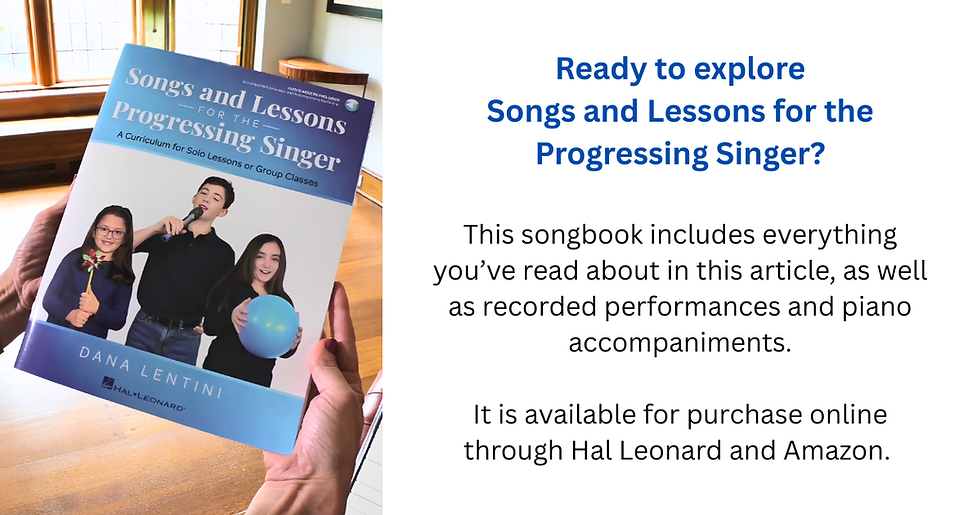
That idea is at the heart of my book, Songs and Lessons for the Progressing Singer.
Designed to build upon the foundational skills introduced in Songs and Lessons for the Beginning Singer, this second book in the series gives progressing singers opportunities to explore greater musical independence, expression, and vocal coordination while discovering the styles, sounds, and repertoire that fit their own developing voices.
But this isn’t simply a collection of sheet music.
Each of the 15 songs becomes a complete learning experience, combining repertoire with vocal exercises, musical discovery, technique, creative activities, independent practice, and performance skills.
And while those are all components of voice lessons that sound important, you may be wondering, “How exactly do those components show up in these songbooks?
In this article, I’m going to take you inside Songs and Lessons for the Progressing Singer and show you exactly what you can expect.
The Songs
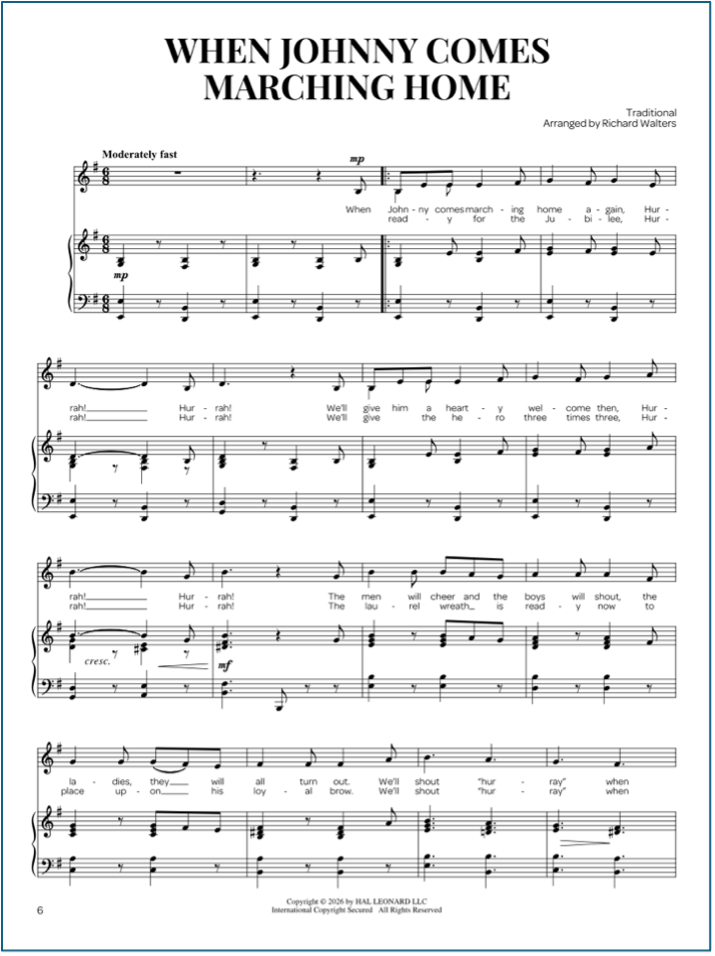
Developing singers can benefit from experiencing more than one kind of music, and the repertoire in Songs and Lessons for the Progressing Singer was intentionally selected to introduce a variety of musical experiences while supporting healthy vocal coordination.
The collection includes fifteen songs spanning different musical styles and cultures, including traditional and folk music, musical theatre, popular music, spirituals, and newly composed songs, with opportunities to explore music and languages from different cultures.
Here are the 15 songs you will find in Songs and Lessons for the Progressing Singer:
1. “When Johnny Comes Marching Home” — Traditional folk song; arranged by Richard Walters
2. “In Our Own Backyard” — Contemporary art song; Words and Music by Michael Ching
3. “Martin Luther King’s Dream” — Contemporary pop song; Words and Music by Kira Rappaport and Kymberly Stewart
4. “Dona Nobis Pacem” — Traditional sacred canon
5. “Curiosity” — Contemporary art song; Words and Music by Nick Vall; arranged by Glyn Lehmann
6. “Feelings” — Contemporary art song; Words and Music by Glyn Lehmann
7. “Rockin’ Robin” — Pop song; Words and Music by J. Thomas
8. “Las Mañanitas” — Mexican Folk Song; arranged by Linda Fletcher
9. “The Gospel Train” — African American Spiritual; arranged by Richard Walters
10. “Navrai Majhi” — Marathi folk song; arranged by Sandra Oberoi
11. “Jack Was Every Inch a Sailor” — Newfoundland Folk Song; arranged by Linda Fletcher
12. “Just Passing By” — Contemporary art song; Words and Music by Donna Rhodenizer
13. “Over the Rainbow” — Film musical song; Words and Music by Harold Arlen and E. Y. “Yip” Harburg
14. “Blackbird” — Pop song; Words and Music by John Lennon and Paul McCartney
15. “The Ugly Bug Ball” — Disney film musical song; Words and Music by Richard M. Sherman and Robert B. Sherman
The sheet music includes the vocal line as well as piano accompaniment, with tempo and dynamic marks. Many also include chord symbols.
Recorded performances and piano accompaniments are also provided so singers and teachers can hear and work with the music outside the lesson setting. The recordings feature eight young singers between the ages of 9 and 13.
But the songs are only one part of the book.
Activity Pages
One of the most important features of Songs and Lessons for the Progressing Singer is the structure surrounding each piece.
Rather than separating vocal technique, research, musicality, practicing, and performance from repertoire, the activity pages help singers discover how the skills they are learning apply directly to the music they are singing.
The activity pages are in black and white in the printed version of the songbook and in color in the digital version.
Each song includes six learning components:
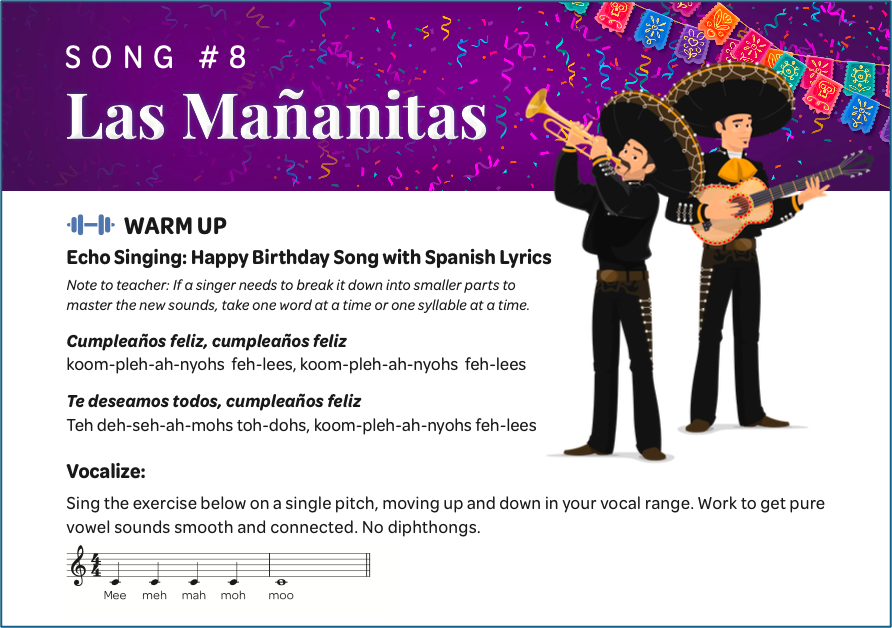
The Warm Up section from "Las Mañanitas"
Warm Up
Every lesson begins by preparing the singer’s mind, body, and voice for the skills they will use in the song.
The warm ups vary throughout the book. Singers might stretch or move, practice breathing, play rhythm or echo games, work with tongue twisters, listen intentionally, explore different areas of the voice, or sing vocal exercises related to the technical objective of the song.
For example, “When Johnny Comes Marching Home Again” begins with a full-body star stretch before moving into vocal exercises involving dynamics and audiation.
“Las Mañanitas” begins by introducing Spanish through echo singing before the singer works on singing in a new language.
“The Gospel Train” begins with breath motion exercises that prepare the singer for the lesson’s focus on efficient breathing.
Every part of the warm up was specifically chosen to support the song. The goal is not simply to “warm up the voice,” but to prepare for the specific musical and vocal work ahead.

The Discovery section from "Navrai Majhi"
Discovery
Words and stories make singing about much more than correct pitches and vocal technique.
The Discovery section helps singers understand the world surrounding each song: its story, history, culture, language, meaning, or emotional context.
A singer working on “When Johnny Comes Marching Home Again,” for example, learns about the song’s Civil War history and considers what its story may have meant to the people who originally sang it.
“Las Mañanitas” introduces the tradition of the Mexican birthday song and mariachi music while helping singers explore unfamiliar Spanish words and sounds.
“Navrai Majhi” introduces singers to Indian culture and music, including Sargam, ragas, talas, traditional instruments, and the song’s role in wedding celebrations.
These discoveries give young singers something important to sing about. Technique becomes connected to communication rather than existing as an isolated exercise.

The Technique section from "Feelings"
Technique
Each song then focuses on a particular technique to improve musicianship, vocal technique, or performance technique.
Across the book, singers explore skills including dynamics, vocal registration, pure vowels, harmony, diction and articulation, breath motion and management, a cappella singing, legato, memorization strategies, musical style, and performance expression.
Like the other sections, the techniques are tied directly to the repertoire.
In “Martin Luther King’s Dream,” singers explore registration and experiment with finding a middle voice that mixes lighter and heavier sounds.
“Feelings” introduces harmony through a practical exercise in which teacher and singer alternate between moving pitches and sustained notes.
“Just Passing By” explores legato singing, helping the singer connect pitches and vowels into a smooth musical line that supports the bittersweet character of the song.
And “Blackbird” gives singers an opportunity to explore pop/rock style, including scoops, glottal onset, and riffs, while emphasizing that stylistic choices should remain comfortable, purposeful, and free from strain.
Rather than learning a technique and wondering where to use it, singers experience the technique inside the song study and performance.
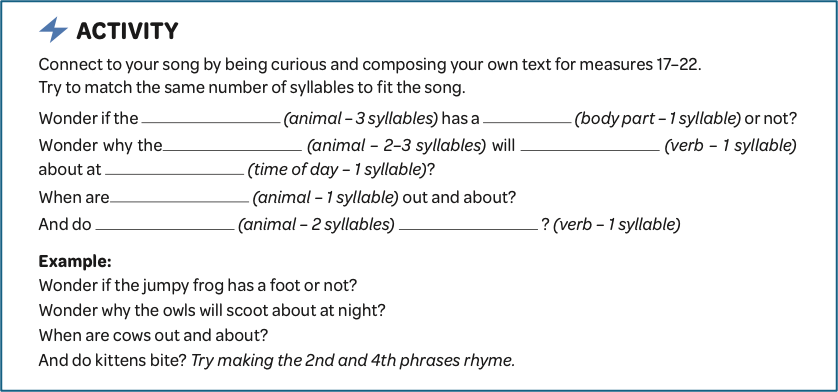
The Activity section of "Curiosity"
Activity
Next, the singer gets to do something with what they have learned.
The Activity sections invite singers to interact with the music through writing, listening, movement, creativity, analysis, reflection, and experimentation.
In “Curiosity,” for example, singers practice being curious by creating new lyrics of their own while matching the song’s existing syllabic structure.
In “Feelings,” singers identify emotion words, explore them through word painting, and even associate emotions with colors.
In “The Gospel Train,” singers work with vocabulary connected to the history and meaning of the spiritual, including freedom, hope, tolerance, and enslavement.
The activities turn the singer from a passive recipient of instruction into an active participant in the lesson.
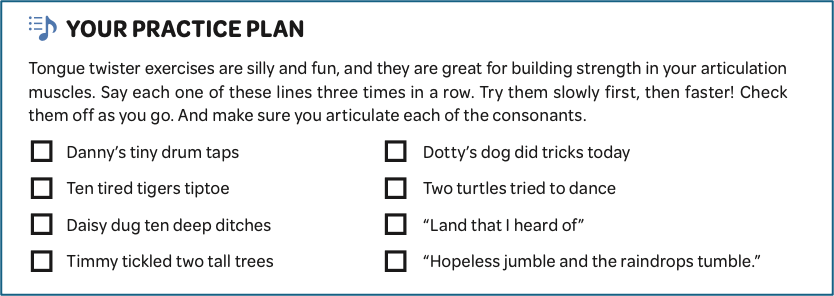
The Your Practice Plan section of “Over the Rainbow”
Your Practice Plan
Learning to practice independently is itself a skill.
That’s why every song includes a practice plan designed to help the singer continue working between lessons.
Rather than simply telling students to “practice your song,” the book provides specific ideas to listen for, experiment with, mark, repeat, or explore.
While studying “Navrai Majhi,” for example, singers are encouraged to practice familiar music a cappella, listening carefully to pitch and maintaining a steady beat without relying on instrumental accompaniment.
In “Over the Rainbow,” singers practice tongue twisters to work on articulation.
These practice plans help progressing singers begin taking greater responsibility for their own musical development while still giving them structure.

The Performing Tips section from “Jack Was Every Inch a Sailor”
Performing Tips
Finally, every lesson connects the work in the practice room to the experience of sharing music with an audience.
The Performing Tips sections explore ideas such as communication, focus, expression, movement, confidence, storytelling, stylistic choices, and recovering when something doesn't go exactly as planned.
That last part matters.
Performance is not about achieving a perfect result, but an opportunity to use the skills a singer has developed to communicate something meaningful.
In “Jack Was Every Inch a Sailor,” singers are given guidelines to help the audience see the scene the singer is painting with their words and gestures.
By the final song, singers are invited to look back at what they have learned throughout the entire book and prepare a small set of favorite songs as a final celebration of their growth.
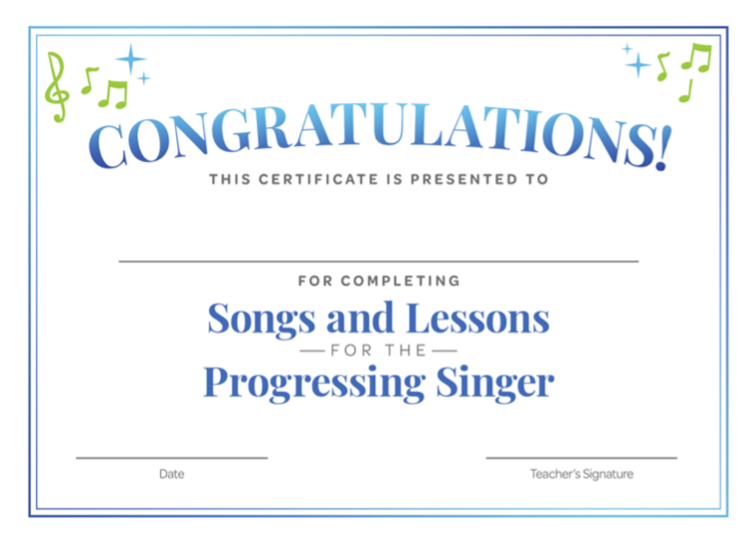
Certificate
At the back of the book is a Certificate of Completion that teachers can award to singers who complete the book’s curriculum. It can be helpful for students to work toward a goal, and having a representation of completing a goal can help students to recognize their commitment to growth.
Building Skills Progressively
Skills including expression, articulation, diction, breath coordination, registration, phrasing, rhythm, style, and performance practice are revisited and expanded as the singer moves through the book.
That means a skill introduced in one lesson doesn't necessarily disappear when the singer turns the page.
Earlier ideas return in new contexts.
By the final song, “The Ugly Bug Ball,” for example, singers review breath management, legato singing, dynamics, articulation, expression, note reading, and performance skills that have appeared throughout the book.
The result is a progression from learning individual concepts toward integrating them.
And while the order of the lessons is intentional, they were also built to stand alone so they can be taken out of order when desired.
A Resource for Singers and Voice Teachers
Although the activities are written directly to the developing singer, Songs and Lessons for the Progressing Singer was also designed to support teachers with repertoire selection and lesson planning.
A teacher can use the material sequentially or draw from individual songs and activities based on what a particular student is ready to explore.
One student may be ready to work on breath management. Another may benefit from diction and articulation. Another may be learning to sing in a new language or explore a different musical style. Another may have solid vocal skills but need more experience connecting technique with storytelling and performance.
The songs provide the repertoire. The lessons provide a framework for exploring it. And the activities give the singer and teacher a place to experiment together.
Helping Developing Singers Discover Their Own Voices
One theme appears again and again throughout Songs and Lessons for the Progressing Singer: there isn't only one way to be a singer.
Young voices are still developing. So are musical preferences, artistic instincts, confidence, independence, and identity.
The purpose of the book goes beyond the 15 songs. It is to give progressing singers opportunities to discover what their voices can do and how technique, musicianship, expression, and communication work together.
The final lesson brings that idea full circle. In “The Ugly Bug Ball,” singers reflect on what makes their own voices unique, what they have learned, what they are proud of, and what they want to continue developing.
Progress is more than singing higher notes, longer phrases, clearer consonants, or more difficult repertoire.
It's also about becoming a more curious, capable, expressive, and independent singer.
Songs and Lessons for the Progressing Singer was created to help make that journey both purposeful and fun.