Beyond the Beginning: How to Know When a Young Singer Is Ready to Progress


There is an interesting stage in teaching young singers when they are clearly no longer beginners, but they are not yet ready for the kinds of vocal demands we associate with more mature singers.
They know how a voice lesson works. They have learned some basic concepts about breath, posture, registration, diction, and expression. They can learn songs more quickly than they once did. They may be eager for something “harder.”
So what comes next?
This is where I think it is especially important to remember that progress does not necessarily mean increasing vocal difficulty. A young singer can be ready for greater challenge without being ready for greater vocal demand.
In fact, some of the most important signs of progress have less to do with what a singer can produce and more to do with what they can understand, notice, and do independently.
Look for Independence, Not Just Ability
Beginning singers naturally rely heavily on their teachers. We demonstrate, remind, redirect, and help them make connections between what they hear, what they feel, and what they are trying to accomplish.
As young singers progress, some of that responsibility can gradually begin to shift.
A progressing singer may notice that a phrase feels different when they take a more effective breath. They may recognize that they are carrying too much weight into part of their range. They may hear that a rhythm is incorrect before the teacher points it out. They may remember a strategy that worked in a previous lesson and try it again.
Those moments matter.
The goal is not simply for a student to follow instructions more successfully. It is for the student to begin developing the tools to become their own musician.
That means one of the questions I ask when deciding whether a singer is ready to progress is not simply, “Can they do this?” but “How much of this can they begin to do for themselves?”
Listen for Growing Coordination
With young voices, consistency develops over time. We should not expect a child’s voice to behave exactly the same way from lesson to lesson, or even from one part of a lesson to another.
What we can listen for is growing coordination.
Is the singer beginning to move through different areas of the voice with greater ease? Can they make adjustments without adding unnecessary effort? Are breath and phrase becoming more connected? Is articulation becoming clearer without interfering with freedom? Can they sing with energy without equating energy with volume?
These changes may be subtle, but they are significant.
A singer who is developing better coordination does not necessarily need a song with more notes, a wider range, or more dramatic vocal demands. The next challenge might instead be asking for more consistency within material that remains appropriate for their current voice.
Musicianship Matters, Too
It is easy to think about vocal development as the primary measure of advancement, but young singers are also developing as musicians.
A student who once needed considerable help learning a melody may now be able to recognize patterns and learn more independently. Rhythmic accuracy may be improving. They may be able to sustain a longer musical thought or make sense of a more complex phrase.
This gives us many ways to increase challenge without asking the voice to do more than it’s ready for.
We can introduce more interesting rhythms, more sophisticated phrasing, greater stylistic variety, or music that requires more careful listening. We can ask students to make decisions about dynamics, articulation, tempo, and character.
Musical complexity and vocal complexity are not the same thing. That distinction gives teachers a great deal of room to help young singers grow.
Ask for More Expression
One of my favorite areas for progression is interpretation.
A beginning singer may be primarily concerned with remembering the words, singing the right notes, and getting through the song. Once those skills require less attention, there is suddenly room for much more.
What is happening in the song?
Who are you talking to?
Why are you saying this?
What changes from the beginning of the song to the end?
How could you make that change clear to the listener?
These questions allow a singer to become more sophisticated without asking the voice to become more adult.
This is an important distinction because young singers are often surrounded by recordings of mature performers. They may naturally assume that sounding “better” means sounding bigger, louder, more powerful, or more like the artist they admire.
I believe part of our job as voice teachers is to help young singers discover that compelling singing does not require imitation or force. Expression can come from clear intention, thoughtful phrasing, meaningful words, rhythmic energy, dynamic contrast, and confidence in their own sound.
Let Repertoire Grow with the Singer
When students are excited about their progress, they often want harder songs. That enthusiasm is wonderful. But “harder” needs to mean the right kind of harder.
Before introducing new repertoire, I consider what the song is actually asking of the singer.
Does it require sustained singing in an uncomfortable part of their range? Does it encourage pushing or oversinging? Are the musical challenges achievable? Is the text something this singer can understand and communicate authentically?
Most importantly, how will this particular song help them grow?
A good repertoire match should give the singer somewhere to go. Perhaps it introduces a new rhythmic challenge, requires more independence, asks for greater contrast, explores a different musical style, or creates an opportunity to practice a developing coordination.
The next song does not have to prove how advanced the student has become. It should help the student become more advanced.
Challenge the Skill Before Increasing the Demand
There is a temptation, especially with talented young singers, to keep raising the difficulty because they are capable of meeting it.
But capability and readiness are not always the same thing.
A child may be able to produce a particular sound today without that sound being something we should ask them to produce repeatedly. They may be able to sing a demanding song without it being the best song for their developing voice. They may be musically advanced while still needing very age-and-stage-appropriate vocal expectations.
When I want to challenge a progressing singer, I would much rather deepen the skill than simply increase the demand.
Can you sing that phrase again with a different intention?
Can you identify where you want to breathe and explain why?
Can you find three different ways to communicate this line?
Can you listen to your own singing and tell me what you noticed?
Can you carry something we worked on in one song into another?
These are all forms of progression.
The Goal Is Not to Get to Adult Singing Faster
Young singers are in a wonderful period of discovery. Their voices are growing, but so are their ears, their musical instincts, their confidence, their creativity, and their understanding of themselves as performers.
There is no need to rush through that stage.
The goal of teaching a progressing young singer is not to get them to adult singing as quickly as possible. It is to give them increasingly sophisticated tools while allowing the voice itself to develop at an appropriate pace. And that is individual to the student.
Sometimes progress means doing more. But very often, it means hearing more, understanding more, choosing more, and relying a little less on the teacher to make those choices for them.
When we begin looking at progress that way, that middle territory stops being something we need to hurry through.
It becomes one of the richest stages of learning.
🌹
Looking for resources that give you practical tools to build these skills as singers progress?
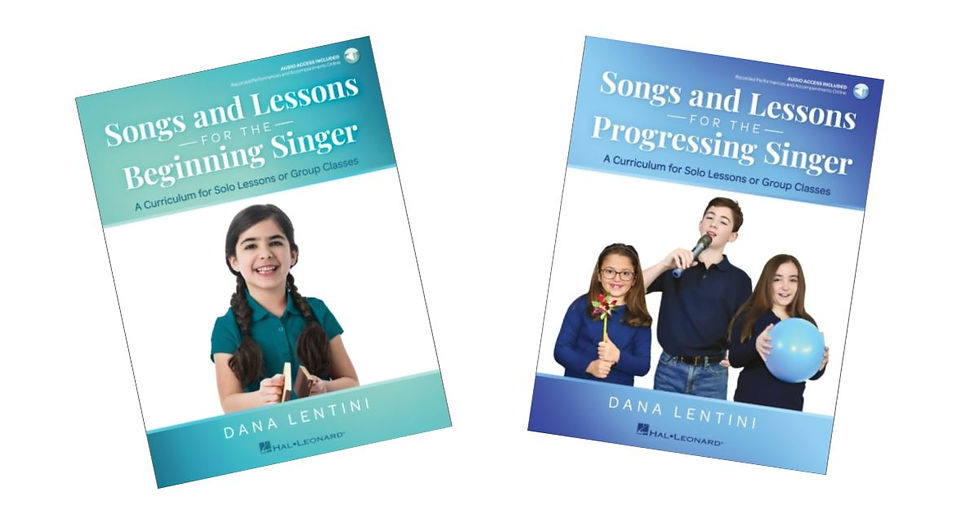
The activity pages in Songs & Lessons for the Beginning Singer and Songs and Lessons for the Progressing Singer were designed to give you not only age- and stage-accessible repertoire, but also repeatable, strategic ways to support singers as they grow.